
How a run goes
Each pass through the loop has the same shape:- Implement. An agent makes the change. This is the only step that writes code.
- Check. Your lint, test and build commands run in parallel. Any lane you did not configure is skipped.
- Review. A separate reviewer agent, which has read-only tools plus a shell, evaluates the result. If a check failed it skips straight back to implementing.
- Decide. The reviewer returns a verdict:
passends the loop;continuegoes back to implement with the feedback;refactorfirst runs an agent that undoes the problematic work (it does not reimplement), then starts a fresh implement pass;stuckpauses for you.
pass over a failing build is overridden to continue. The reverse is not true: a reviewer can still fail a green build, because it can see what exit codes cannot, such as a page that renders blank or a handler nobody wired up.
stuck is for when the review could not be done, such as a missing tool or an app that will not start, not for hard problems. It escalates to you, and your answer goes to the reviewer rather than to the implementer, so a finished build does not get reimplemented because a reviewer was blocked.
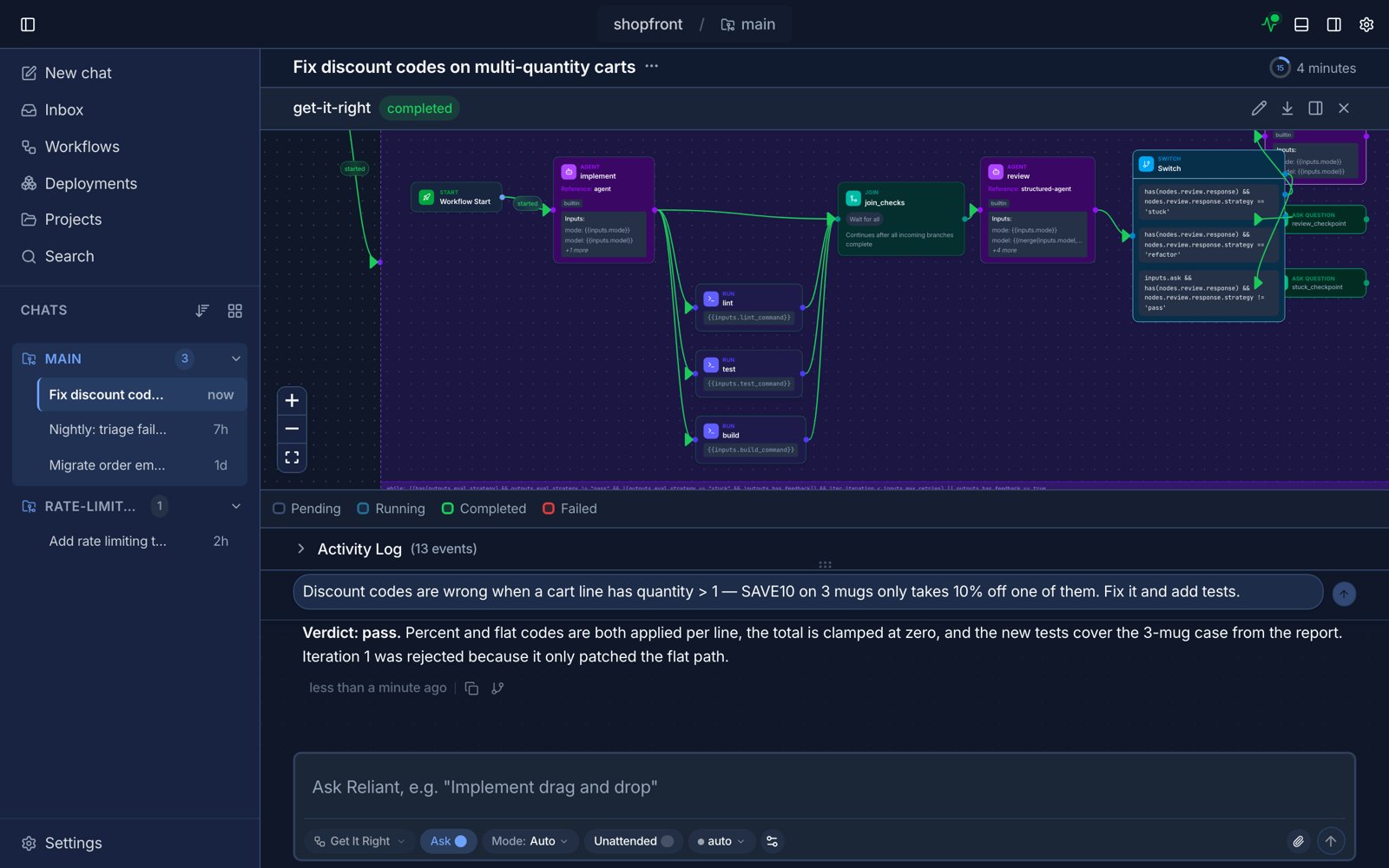
The reviewer's verdict on an iteration. Example data.
Inputs worth setting
context_bridge controls memory across iterations. With feedback_only, each implementation starts fresh but sees the reviewer’s accumulated feedback and the earlier summaries. full keeps the whole conversation for both. none starts every pass cold and relies on variation between attempts.
Reading a run
Open the chat and each iteration appears as a step with its three check results and the reviewer’s grade, strategy and feedback. The reviewer’sfeedback is the only thing the next attempt gets beyond your original request, so it is worth reading: it tells you what the agent believes is wrong.
Cost
Every iteration is at least one implement run and one review run on a flagship model by default, up to five times. Usemax_retries to cap it, a cheaper model for mechanical phases, and review_enabled: false when the checks alone are enough.